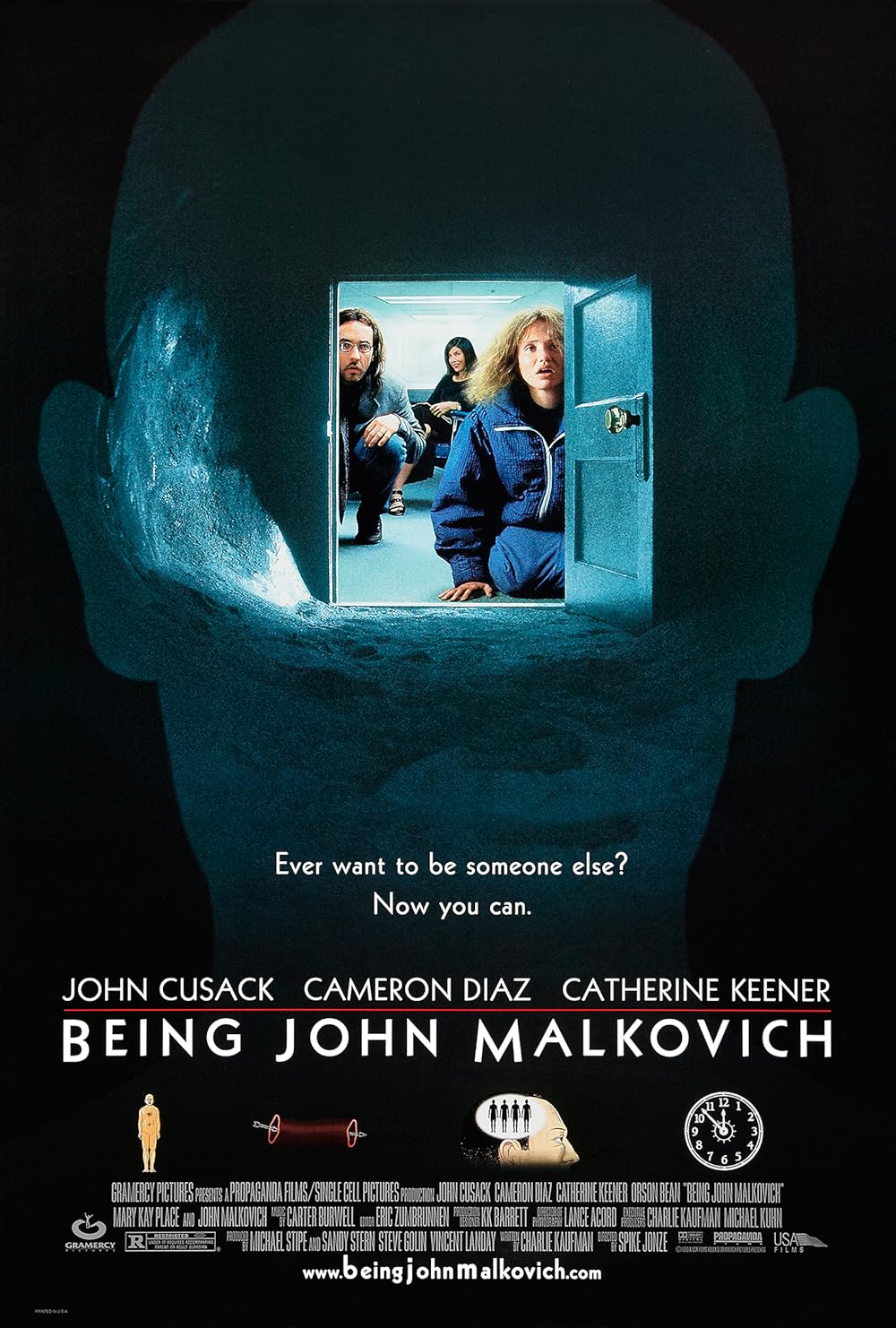
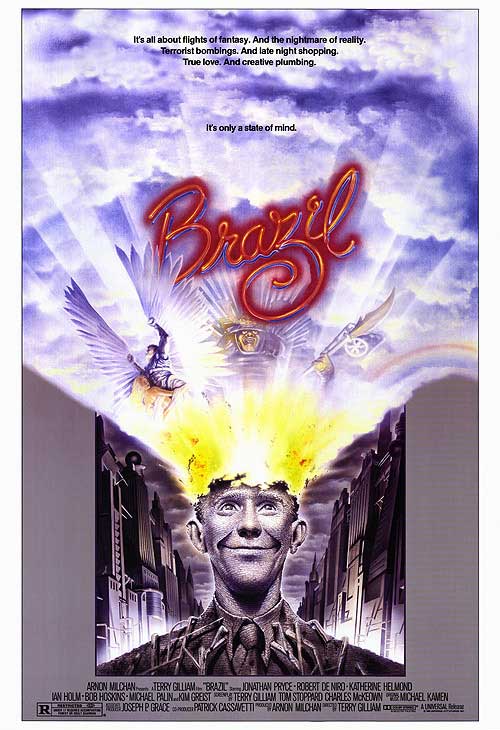
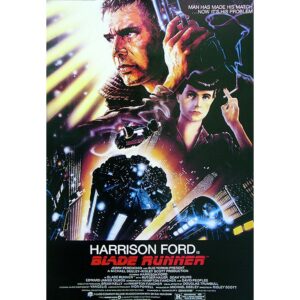
Peter’s Favorite SF Movies Part 8: Being John Malkovich

Cast your mind back to 1999. Bill Clinton is still president, having survived getting impeached over that whole Monica thing, every computer programmer and systems administrator is working overtime to make sure the Y2K bug doesn’t destroy civilization, and Ricky Martin is livin’ La Vida Loca. And a young(ish) me is sitting in a movie theater watching a preview for a movie called Being John Malkovich and thinking, That doesn’t look like any movie I’ve seen before. I have to see it!

And indeed I did to see it on opening night, something I never do. And the movie was, in fact, like no movie I’d seen before. I had never seen a movie so inventive and audacious and downright hilarious.

If by some chance you haven’t seen the movie, here’s the premise: Craig Schwartz, an ambitious but poverty-stricken puppeteer in New York, lives with wife Lotte in a tiny apartment they share with many animals (Lotte owns a pet shop, and takes her work home with her). Craig gets a filing job working for a mysterious company that occupies the 7 1/2th floor of an old office building. After developing a fierce crush on Maxine, an attractive but gleefully cruel woman who works on the same floor, our hero discovers a mysterious tunnel that is in fact a portal that sends him into the mind of John Malkovich. After being inside Malkovich’s head for fifteen minutes, Craig is spat out onto the grass beside the New Jersey Turnpike.

That’s the premise. That’s what we start with. And it only gets weirder from there, with Craig and Lotte competing for the affections of Maxine, who is attracted to both but only when they are inhabiting Malkovich’s body. And there’s Craig’s boss, a sex-obsessed old man who is actually centuries older than he appears. And John Malkovich himself, who takes the portal into his own brain and experiences… well, you have to see it for yourself.

Welcome to the world of Charlie Kaufman, the most original screenwriter in American film in the past thirty years. Kaufman is a genius at coming up with a ridiculous idea and following it through various permutations to a conclusion that is perfectly logical and highly nonsensical at the same time. For Malkovich, he is joined by director Spike Jonze, whose sensibilities mesh with Kaufman’s perfectly, giving us a movie that takes us through the heights of absurdity so compellingly (and hilariously) that we have no choice but to go along.

Part of the absurdity is in the casting. For his leads, Jonze selected John Cusack and Cameron Diaz, two of the most attractive and glamorous stars of the age, and then had them play the roles in dowdy clothes and unkempt hair. For Maxine, Jonze cast then-unknown (well, at least unknown to me at the time) Catherine Keener, the perfect choice to make gleeful malice seem sexy. There’s also Orson Bean as the creepy old boss, Mary Kay Place as his hard-of-hearing assistant, and — oh, yes — John Malkovich in the role of a lifetime as the hapless actor John Malkovich.

In my essay on Brazil, I noted that you can get away with much more darkness in a comedy than in a drama. And Being John Malkovich is as dark as a comedy can be without an actual body count. All of the characters, apart from Malkovich himself (and possibly Elijah the chimp), are completely amoral self-centered sociopaths who have no moral qualms about using Malkovich’s body for their own purposes. Craig and Lotte, in particular, are perfectly willing to throw each other under the bus in order to gain favor with Maxine (behavior which Maxine seems happy to encourage). In the hands of lesser artists, such obnoxious characters would make the movie near unwatchable. (And if you haven’t seen the movie, you may wonder why you’d want to spend two hours with such jerks.) But Kaufman, Jonze, and the cast manage to make the characters — well, not likeable, perhaps, but at least relatable. Stuck in dead-end jobs and unhappy lives, how can they pass up an opportunity to spend a few minutes as the glamorous actor John Malkovich? (And of course much of the humor comes from the fact that these experiences are utterly mundane: Malkovich rides in a taxi. Malkovich takes a shower. Malkovich orders bath towels.)

Much of the genius of the movie is in the details, the perfect little jokes that push the movie forward like the surging waves that propel a boat. Such as Bean’s character being convinced he has a speech impediment because his assistant doesn’t understand him. Or the performance by a rival puppeteer of Belle of Amherst using a 60-foot marionette of Emily Dickinson that enrages Craig. Or the fact that no one can remember what movies Malkovich has been in, except for “that jewel thief movie,” though he is adamant that he has never played a jewel thief.

Enough. If you haven’t seen Being John Malkovich, you owe it to yourself to see it. If you have seen it, then you owe it to yourself to see it again. And as for Charlie Kaufman, we’ll visit with him again in the next installment.

Posted in Peter's Favorite SF Movies | Leave a comment

Peter’s Favorite SF Movies Part 7: Brazil

Surveying Terry Gilliam’s career as a film director is an exercise in frustration and disappointed. Although he possesses a truly original visual imagination and a wonderfully savage sense of humor, his filmography is littered with movies that are dismally mediocre or just downright terrible. (I recently rewatched Jabberwocky, wondering if it was as bad as I remembered it, and it proved to be much, much worse.) Too often, his astounding visuals seem strung together with no real plot (such as The Adventures of Baron Munchausen and The Imaginarium of Doctor Parnassus), and his glee at looking at the ugliness of human life results in a film that, when watching it, the viewer feels like they’re being buried in an avalanche of grossness (see Fear and Loathing in Las Vegas or the aforementioned Jabberwocky). Even some of his more successful films, like Time Bandits and Twelve Monkeys, give the impression of having better movies hidden inside that didn’t get a chance to come out.

But among Gilliam’s works there stand three that are undeniably great. The first, Monty Python and the Holy Grail, co-directed with Terry Jones, is more a product of the collective Python genius than an expression of Gilliam’s own vision. (When Gilliam followed up with another film based on the idea that the Middle Ages was a dirty, shitty, and bloody time, he gave us the disastrous Jabberwocky.) The second great work is the delightful and inventive “The Crimson Personal Assurance,” the short subject that preceded Monty Python’s The Meaning of Life and was arguably better than anything in the latter, with its hilarious blend of corporate satire and piratical derring-do.

Gilliam’s third great work, and his absolute masterpiece, is Brazil.

In Brazil, everything clicks. The stunning visuals are wedded to a well-crafted story. The pessimistic view of human nature is leavened by humor that is actually funny, and characters that are more than just caricatures. It is one of the greatest movies ever made.

I was twenty when I first saw it. As I recall, I went to see it in the theater three times — I just couldn’t get enough of it. It seemed to me to be the perfect movie. Certainly, it pushed all of my buttons. The political satire, the dark humor, the surreal fantasy sequences, the gleeful absurdism — it was a combination of all the things I most liked in my art, combined together in a way that shouldn’t have worked at all, but did.

Brazil is set “somewhere in the 20th Century” in an unnamed country that has elements of both British and American culture. (But not Brazilian: The title refers to the classic song, not the country.) The characters all speak with their actors’ accents, so we have oddities such as protagonist Sam Lowry (Jonathan Pryce) speaking with a crisp BBC accent, while his mother (Katherine Helmond) talks like an American. Though ostensibly set in the “future,” the aesthetic is more mid-20th Century. It’s how people in 1948 might have thought the future would look like.

In this dystopia, the oppressive government oversees all aspects of people’s lives, similar to that in Nineteen Eighty-Four. However, unlike the ruthlessly efficient ministries of Orwell’s work, the regime in Brazil is a tangled web of bureaucratic red tape and sheer incompetence. If anything, this makes them even more terrifying. In Nineteen Eighty-Four, Big Brother will track you down and torture you if you commit thoughtcrime. In Brazil, the government will track you down and torture you if someone with a name similar to yours committed thoughtcrime, and a random typo gets your name mixed up with theirs.

Our protagonist, Sam Lowry, is a Walter Mitty-ish figure who is part of the bureaucracy but fancies himself a hero, losing himself in fantastical dreams in which he is a valiant warrior attempted to save a fair damsel from a giant metallic Samurai monster. When he meets a young woman named Jill (Kim Griest) who looks exactly like his imagined heroine, he becomes obsessed with her, and uses his resources to track her down and “rescue” her — but his efforts end up dooming them both.

The movie would be depressing to watch if it weren’t also absolutely hilarious. (All of which goes to show that comedies can get away with being a lot bleaker than tragedies.) The movie is filled with absurdities: a government official chastising terrorists for “poor sportsmanship”; Sam’s mother getting plastic surgery that literally turns her face elastic; Sam stuck in a tiny office with half a desk, which he wrestles to keep from being dragged into the office next door; a fancy restaurant displaying elegant dishes but serving bland piles of mush on plates; an apologetic guard knocking Sam to the floor (“Sorry, sir. Regulations.”), and on and on.

It helps that Gilliam was able to assemble a dream cast. Aside from Pryce and Helmond, the actors include Robert De Niro, Ian Holm, Michael Palin (in possibly the best role of his career as the most affable torturer imaginable), Bob Hoskins, Jim Broadbent, and many a British character actor that you will recognize by sight, if not name.

I said above that when I was twenty I considered Brazil to be the perfect movie. Looking at it today, I can see that it has one flaw, that being the character of Jill. It’s true that Gilliam was apparently unhappy with the performance of Griest, who was not his first pick for the role. (Allegedly, he considered having Madonna play the role, which would have been an… interesting choice.) But to be fair, it may not be Griest’s fault. The character is thinly written. Gilliam intended to set up a contrast between the fantasy figure that Sam sees in his dreams, and the actual human being that he meets in reality. But Jill is still a fantasy figure: he destroys her life, but she is apparently just fine with sleeping with him. (A female friend of mine with whom I saw the movie once could not get past that.)

Nonetheless, the film remains as the peak of Terry Gilliam’s film career. What made this one work so well, compared to his other movies? Perhaps it was the fact that Gilliam had a concept that played to all of his strengths as a director, and none of his weaknesses. Perhaps it was the inclusion of Tom Stoppard (whose genius with words and plots was equal to Gilliam’s genius with images) among the screenwriters (who also included Charles McKeown and Gilliam himself). Perhaps it was one of those results of a simple confluence of events that cause everything to come out right, and for that we can be thankful.

Posted in Peter's Favorite SF Movies | Leave a comment

Back to the Marathon

Regular readers of this blog (of whom there are, I think, none) know that I was a playwright up until the Pandemic, at which point it switched over to writing stories. (I wrote a post about it, if you want details.)

Since then, I did not write a single play. Until last fall, that is, when I had the urge to write a ten-minute play called “The Intervention.” The play was accepted to the Boston Theater Marathon, to my delight — it will be my first appearance in the BTM in six years! It will be produced by Dream Role Productions, and directed by Peter Duerst.

The Marathon will be at the Boston Playwrights’ Theatre on Sunday, May 4. Ticket information is here. The format of the Marathon has changed since the old days; tickets are reserved for two hour blocks. (“The Intervention” will be in the 3:00 – 5:00 block, but do plan to see more than one block if you go.)

Boston Theater Marathon XXVII
Boston Playwrights’ Theatre
949 Commonwealth Ave.
Boston, MA 02115
May 4, 2025

Posted in Uncategorized | Leave a comment

Peter’s Favorite SF Movies Part 6: Repo Man

“The life of a repo man is always intense.”

Can you recommend a movie on the basis of its soundtrack album alone? Probably not, and Repo Man certainly has a lot going for it besides its background music, but damn, that soundtrack is great. Back in the mid-’80s, it seemed to be playing everywhere — well, at least in my college dorm. Wander down the halls, and you could hear the songs playing in one room after another: “Institutionalized” by Suicidal Tendencies, “Pablo Picasso” by Burning Sensations, “TV Party” by Black Flag, “When the Shit Hits the Fan” by the Circle Jerks, “Repo Man” by old man Iggy Pop… For most of us, it was our first taste (and, let’s be honest, pretty much the last) of the L.A. punk scene, far fiercer and more primal than East Coast punk (compared to these guys, the Ramones were cute and cuddly).

“I don’t want no commies in my car. No Christians, either.”

But what about the movie itself? Repo Man is a true punk film, with a screw-you attitude and a chip on its shoulder. (It’s no surprise that its director, Alex Cox, would go on to direct Sid and Nancy.) Prickly and punchy, it dares you to like it. The hero, Otto (Emilio Estevez) is kind of an asshole, and his mentor, Bud (Harry Dean Stanton) is a belligerent sociopath. The title profession is one that most people would rate somewhere between IRS auditor and grave robber in terms of popularity. Why would you want to sit through an hour-and-a-half-long movie with these bozos? Well, because it’s absolutely hilarious and bloody brilliant, that’s why.

“The more you drive, the less intelligent you are.”

Otto is suckered into taking part in a repo job by Bud, and as he needs the money (his parents have given all of his college fund to a TV preacher), he reluctantly becomes a regular, becoming adept at legal carjacking. What follows is a series of incidents as Bud, Otto, and their repo crew steal cars, get into fights (with car owners, a rival repo team, and each other), and sit around talking trash. They consider themselves above the rest of humanity (they’ve got a code!) yet seem to embody the worst of it.

“Suppose you’re thinking about a plate o’ shrimp. Suddenly someone will say, like, plate, or shrimp, or plate o’ shrimp out of the blue, no explanation. No point in looking for one either.”

Wait, isn’t this supposed to be a science fiction movie? Oh, yes, there’s a mad scientist driving around in a 1964 Chevy Malibu with a couple of dead alien bodies in the trunk, so radioactive that they incinerate anyone who looks at them. A secretive government agency is trying to track them down, as is a group of scientists (one of whom briefly becomes Otto’s kinda-girlfriend). Over the course of the movie, the car gets stolen by one group after another, and several people get disintegrated. Where did the aliens come from, and why are they so destructive? The movie doesn’t particularly care, so why should me?

“Let’s go do some crimes!”
“Yeah, let’s go get sushi and not pay.”

Some of the gags are a bit dated, such as the running gag about generic products in plain white containers (here, especially generic: “Food” and “Drink”), based on a barely-remembered fad that lasted for a couple of years in the early 80s. But generally speaking, the humor holds up well. The comedy of people behaving badly never gets old. And some many of the lines are quotable, or at least were quoted, over and over, in my mid-80s dorm. It helps that the entire cast (who, aside from Estevez and Stanton, were unknowns then and remain so today) is committed to the movie’s absurdities, especially Fox Harris (who doesn’t even get a picture in the IMDB) as the mad professor, lovingly chewing up the scenery and spitting it back out again.

“Don’t go! What about our relationship?”
“Fuck that.”

But above all it’s Stanton who shines in what perhaps is his most seminal role. Roger Ebert once said that “No movie featuring either Harry Dean Stanton or M. Emmet Walsh in a supporting role can be altogether bad,” and that’s the case here. Stanton appeared in a lot of great movies, including Wise Blood, The Godfather Part II, Alien, The Lat Temptation of Christ, Cool Hand Luke, and In the Heat of the Night, but he was never more iconic than here, playing the quintessential repo man, grumbling, “Ordinary fucking people. I hate ’em.” He’s the kind of guy you’d never want to meet in real life unless you were in an extremely tight situation, and then you’d be glad to have him on your side.

“I know a life of crime led me to this sorry fate, and yet I blame society.”

Not to sound like your grandfather, but: Repo Man is the kind of movie that wouldn’t get made these days. In this age of CGI, you’d never get away with the cheesy special effects and backlot sets. Too many cheap movies of the 21st Century come across as slick and soulless. I miss the attitude of movies like Repo Man, a movie that feels like it’s going to punch you in the face or shiv you between the ribs, but ends up gloriously entertaining you. Is there room for punk in the 2020s?

“You ever feel as if your mind had started to erode?”

Posted in Peter's Favorite SF Movies | Leave a comment

Peter’s Favorite SF Movies Part 5: Blade Runner

In the summer of 1982, a memorable science fiction film hit the theaters and became an instant phenomenon, becoming the most popular (and most remunerative) movie of the year. That movie was Steven Spielberg’s E.T.: The Extraterrestrial, one of the celebrated director’s most celebrated films, and one that is still popular over forty years later.

I went to see it that summer, and my verdict was: Ehh…

I was 16 at the time, almost 17, and well on my way to becoming an idealistic cynic. I thought the movie overly sentimental and too cloying by half. When the ugly little alien with the gorgeous blue eyes came back from the dead, the sound of my rolling eyes could have been heard for miles around.

Also coming out that summer was another SF film, this one not nearly as heralded and certainly neither as critically praised or monetarily successful as E.T. I went to see it and my mind exploded.

I had never seen a movie that looked like this before. It depicted a city (Los Angeles in the far distant year of 2019) that was simultaneously beautiful and hideous, full of blazing neon light and endless rain, dazzling futuristic buildings and crumbling ruins. Much of the populace was non-white, something I’d never seen in an sf movie (or encountered in an sf story, for that matter) at that time. All in all, it was the most original and breathtaking view of a futuristic city that I’d ever seen.

The movie was Ridley Scott’s Blade Runner, of course, and the last sentence of the previous paragraph still stands. Blade Runner was the most groundbreaking depiction of the urban future since Fritz Lang’s Metropolis (which I wouldn’t see for another five years). And I’m not the only one to have this opinion: William Gibson, who was writing Neuromancer at the time he first saw the film, thought the movie was scooping his own work. “The damned movie looked better than the images in my  head!” he would say.

Oh, yes, and layered into the magnificent/horrific cityscape there is a plot, involving Harrison Ford (in a supremely restrained performance) as Rick Deckard, a “blade runner” (bounty hunter) pursuing a band of escaped replicants (essentially biological androids) led by Rutger Hauer and Daryl Hannah, and falling in love with another replicant, played by Sean Young.

Much has been said and written about how the artificial people in the film are much more alive than the actual humans, and whether or not that was a deliberate choice on Ridley Scott’s part. Given that Scott intended Harrison Ford’s character to be a replicant himself, it probably was not, but I agree with critic Danny Peary that the movie is much more interesting if Deckard is biologically human and that he only learns to be fully human from the examples of the “artificial” people he is hunting.

(Denis Villeneuve, when making his sequel Blade Runner 2049, was careful not to tread on anyone’s toes, giving no firm indication as to whether Deckard is human or not.)

Blade Runner is now of course a cult classic, but not only was it generally critically panned on its initial release (much like Alien was), it also was slow to gain acceptance among sf fans. The reason for the latter, I think, is that it is adapted from Philip K. Dick’s novel Do Androids Dream of Electric Sheep, and yet prunes out most of the distinctive traits characteristic of Dick’s work: The large ensemble cast, the questioning of reality, and the general sense of absurdity, among other things. When, many years after I first saw the movie, I read the novel, it felt like a completely different story that just happened to have characters with the same name as the movie. Had I read it first, I too might have found the movie a disappointment, at first. Electric Sheep is, I would say, thematically richer than Blade Runner, but of course it doesn’t have the latter’s powerhouse world-building.

In truth, very few of the film adaptations of Philip Dick’s works fully capture the Dickishness (so to speak) of the novels. Some have been very good (Spielberg’s Minority Report) and some very bad (Paul Verhoeven’s Total Recall), but precious few have embodied the cosmic paranoia and reality-bending that pervade his written word. Honestly, the only adaptation I can think of that does is Rick Linklater’s little-seen adaptation of A Scanner Darkly, which is eminently worth seeing.

But what the movie lacks in Dickesque mind-bendiness, Blade Runner makes up for in Ridley Scott’s visual smorgasbord. Coming on the heels of Alien, Blade Runner seemed to mark Scott as one of the greatest science fiction film directors. He seemed quite ready to acknowledge this himself, telling Harlan Ellison “the time is ripe for a John Ford of science fiction films to come along, and I’m going to be that guy.” He then proceeded to not make another sf film for thirty years, finally coming back to make two poor-to-mediocre Alien spinoffs and the respectable-but-hardly-spectacular The Martian. Of course, he also turned out dozens of other movies, a few making a big splash but many more disappearing without a trace. Even those in the former category (such as Thelma and Louise and Gladiator) are overrated, full of sound and fury and generally signifying nothing. The visual genius behind Alien and Blade Runner seems to have withered away.

But we still have those two masterpieces, and if you’ve made two of the greatest science fiction movies of all time, maybe that’s enough.

Posted in Uncategorized | Leave a comment

Peter’s Favorite SF Movies Part 4: The Empire Strikes Back

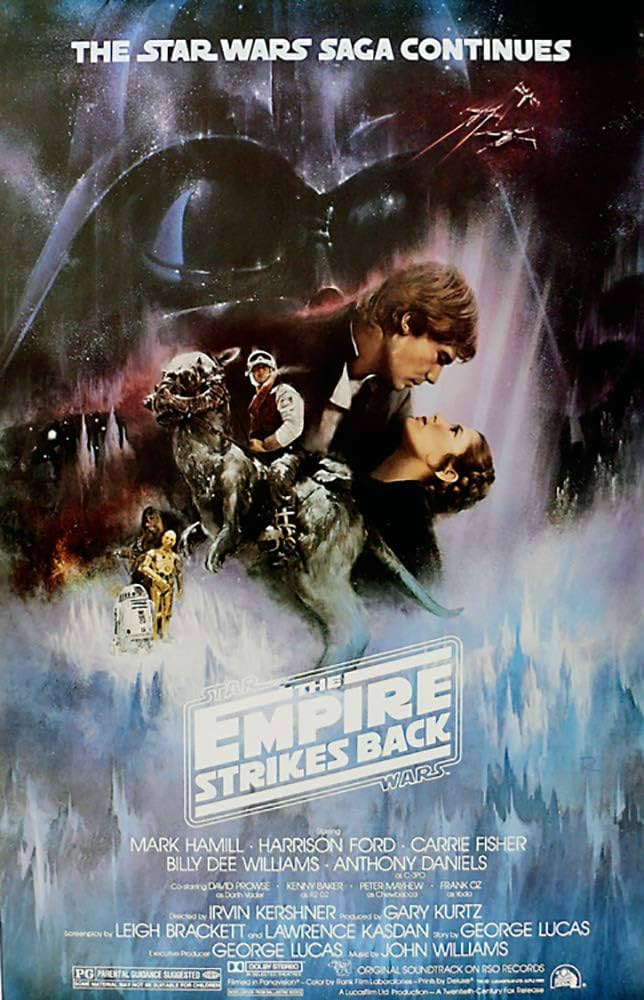
In the summer of 1977, when Star Wars* came out, I turned twelve. That was, I would say, the perfect age to see it. Old enough to appreciate the nearly nonstop action, the astonishing scope, the tremendous cutting-edge visual effects, the smartass humor, and the refreshingly second-hand version of the future**, with spaceships that didn’t look fresh off the assembly line. And young enough not to notice (or at least care about) the hackneyed plot, bland dialog, and Carrie Fisher’s inconsistent accent.

I was a full-fledged Trekkie at the time, a full-on devotee of Gene Roddenberry’s Utopian vision of the future, which appealed to my overly left-brained nature. But Star Wars offered something that “Star Trek” did not. It bypassed the brain completely, aiming straight for the gut with its Joseph Campbell archetypes, awesome spectacle, and laser guns blasting at 24 frames per second. How could I resist? And to this day, whenever I see it again (I try to avoid the special edition for reasons too obvious to mention), even though I can recognize the movie’s numerous flaws, I revert to that almost-twelve-year-old kid and get sucked in as if forty-seven years hadn’t passed.

In the decades since then, Star Wars became a franchise, then an institution, and then a mythology. There have been so many TV shows, games, novels, comics, and, of course, follow-up movies that to try to list them all would be an exercise in futility. As in most such cases, each succeeding product seems to take away from rather than add to the spirit of the original. (It’s almost impossible to follow any of the Star Wars shows on Disney+ unless you watch all of the Star Wars show.) The law of diminishing returns has been in play for decades, now.

But that is now. Back in 1980, when The Empire Strikes Back was released, it was the very first expansion of the original. (If you don’t count a handful of novels, the Marvel comics series, and the Holiday Special, that is.) I was nearly fifteen when it came out, and was thus not the same starry-eyed kid from 1977. (Really, there is more change and growth between the ages of twelve and fifteen than there is between fifteen and fifty, but that is a subject for another day.) I had matured a lot, though probably not as much as I felt I had, and where science fiction was concerned I’d shelved my mania for “Star Trek,” having discovered the works of Asimov, Clarke, Heinlein, and the like.

But of course, I was not made of stone, so I naturally went to see Empire. And, what do you know, I loved it. There were plenty of wonderful action scenes, of course, from the snow battle on Hoth to the Millennium Falcon dodging TIE fighters while trying to navigate an asteroid belt. But beyond that, the movie was richer than its predecessor. The characters were developing in interesting directions, what with Luke learning how to use the force, Leia and Han reluctantly falling in love, and C-3PO becoming less annoying. (Ha, I’m just kidding about that last one.) We are introduced to new characters like Yoda, who these days is a walking, talking cliché but back in 1980 was a fresh take on the mentor character, a wizened gnome speaking with the voice of Fozzie Bear. And Lando Calrissian, who provided both a dash of moral complexity and a break in the cavalcade of whiteness of the movie’s human characters.

And of course, there was the ending. First, the revelation of Luke’s parentage, as Darth Vader says “I am your father!” (I don’t have to mark that as a spoiler, do I? That’s probably the most well-known final-reel revelation in moviedom, beating even “Rosebud was his sled.”) I still remember hearing that line for the first time and thinking, “Okay, that can’t be true!” (Once again, it’s become a cliché in the Star Wars universe that everyone is related to everyone else — by the next movie, when it turned out that Luke and Leia were siblings, I was rolling my eyes — but in 1980 this was a major revelation.) And then there was the cliffhanger at the very end, with Han encased in carbonite. While there was some precedence for this — the movie serials that George Lucas grew up watching — this may be the first time that the audience was expected to wait three full years to see the resolution.

I have found that, unlike the first movie, Empire is a movie I can fully enjoy when seeing it again without reservation. The acting is much improved (Hamill and Fisher in particular have relaxed into their rolls), the dialogue is sharper and funnier, and the overall plot less hackneyed. This may be due to having an old hand like Irvin Kershner at the director’s helm this time. Or maybe it’s due to having an old hand like Leigh Brackett working on the screenplay. or, maybe it’s due to George Lucas keeping himself at arm’s length from the film’s production this time.

Whatever is the case, it was a nice peak that the franchise had been unable to match in the nearly forty-five years that have passed since then.

*Yeah, yeah, we’re supposed to call it A New Hope now, but does anybody do that?

**Yes, I do know that the setting is in fact “a long time ago,” not the future.

Posted in Peter's Favorite SF Movies | Leave a comment

“The Third Wish” on PodCastle

I am pleased to report that my new short story “The Third Wish” has been published/recorded by the fantasy podcast PodCastle, and is available on their website in both text and audio formats, so you may read it or listen to it, whichever is your preference. (You can even read it while listening to it, if that is your bent.)

In “The Third Wish the necromancer Martok the Magnificent conjures up a spirit (a genie?  a demon? an n-dimensional higher being who straddles the universes?) to fulfill his every wish, each of which is more unsavory than the last. (All of them involve smiting his many enemies in profoundly unpleasant ways.) The spirit has no interest in carrying out such terrible desires. Can he/she/it they prevent death and mayhem, while still obeying the necromancer’s commands to the letter?

I would like to thank the editorial staff of Podcastle for accepting “The Third Wish.” Special kudos go to Eleanor R. Wood, who worked with me on getting the story into shape for publication. I would also like to commend Graeme Dunlop for his bang-up job in narrating the story for the audio version.

Posted in The Third Wish | Leave a comment

Peter’s Favorite SF Movies Part 3: Alien

WARNING: This review contains spoilers for a 45-year old movie that you really should already have seen by now.

I was obsessed with Alien for years before I ever saw it.

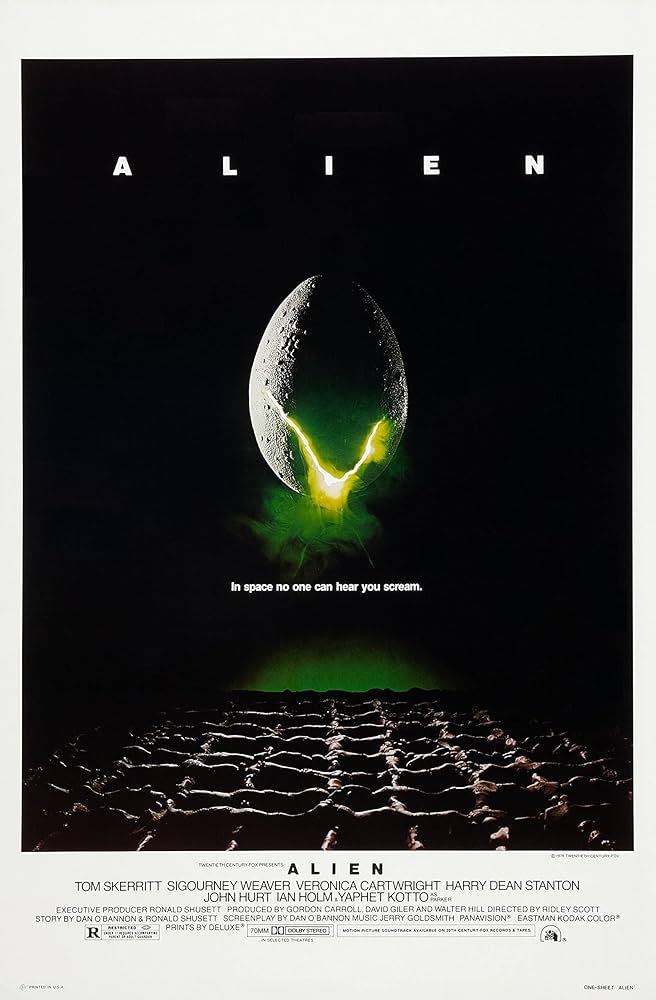
The film came out in the summer of 1979, the year I turned fourteen. I remember the remarkably effective ads on TV, featuring an unearthly egg, cratered like the moon (and looking nothing like the eggs seen in the movie, by the way) starting to hatch, accompanied by that immortal tagline: In space no one can hear you scream. Woo! Cue the tingling of the spine.
And then I read issues of Omni magazine that featured articles and photos from the movie, showcasing designer H.R. Giger’s viscid creations: the ancient spacecraft shaped like a malformed horseshoe, slick corridors that seemed like the inside of a shark’s intestines, and the glutinous podlike eggs. There were no images of the alien* itself, of course, to limit spoilers, but what I could see was enough to get me hooked. This vision of spaceship that seemed more organic than mechanical was a kind of science fiction far removed from “Star Trek” and Star Wars.

But of course I could not see it then. At that time, I only went to the movies if someone in the family took me, and none of them was irresponsible to take me to a hard-R-rated horror flick, revolutionary visuals or no. And I wasn’t ready to see it, really; I was a bit too susceptible to the effects of horror movies and television. When I was a few years younger, I would eagerly watch “The Night Stalker” on TV, and then have to spend the night in my parents’ bed because I was too terrified to be alone. Later, after watching John Carpenter’s Halloween, edited and sanitized for TV though it was, I could not sleep a wink afterwards. So, even at 14, I was self-aware enough to know that I was not yet mentally prepared to see whatever horrible things the alien did to people.

At least, not on celluloid. In the local bookstore, I found a comic adaptation of the movie (by comic legends Archie Goodwin and Walt Simonson, though their names were unfamiliar to me at the time), which I paged through with eager hands. Later, I borrowed the book of film’s novelization, by Alan Dean Foster (the king of SF movie novelizations in the late seventies and eighties; he must have written about thirty of them), which prissily omitted all the profanity but kept all the slime and blood. These were poor substitutes for the actual movie, to be sure, but they kept me turning the pages.

It was not until my college years that I finally saw the film itself and, miraculously, it did not disappoint. Naturally, by that point I knew the plot backwards and forwards, down to the order that the crew of the space freighter Nostromo get picked off by the alien, but for the first time I could appreciate Ridley’s Scott’s masterful direction, with the suspense slowly ratcheting up through the first half as the crew land on a forbidding planet, investigate the derelict spacecraft, and then begin nosing among those alien pods, before turning up the horror factor as the alien goes on its killing spree. The visual design is key, not just with the organic derelict craft, but also with the Nostromo itself, whose interiors range from claustrophobic corridors to sterile medical labs to vast storerooms, all of which come across as sinister and unsettling places.

Another element that I could only appreciate by seeing the movie was the quality of the cast. This must be one of the best ensemble of actors to appear together in a horror film: Tom Skerritt, John Hurt, Ian Holm, Yaphet Kotto, Harry Dean Stanton, Veronica Cartwright, along with a little-known actress named Sigourney Weaver.

Weaver’s Ripley, the film’s sole survivor (aside from Jones the cat) of the alien’s rampage, would become the character primarily associated with the Alien franchise — so much so that it’s  hard to watch the movie and not see her as the heroine, whose survival is a foregone conclusion. However, she’s not actually played that way through most of the film. From the start, it’s Skerritt, playing the ship’s captain, who dominates the scenes and drives most of the action. Indeed, of all the cast, Ripley at first seems the most minor of characters. Certainly, Weaver was the least known of all the cast in 1979. In her early scenes, Ripley is officious and overly by-the-book, hardly what you’d call an action hero. But Alien is not an action movie.

In subsequent films of the franchise, Ripley is an action hero, most notably in James Cameron’s follow-up Aliens. There is much discussion in fan pages and movie review of which is better, Scott’s or Cameron’s movie, and more often than not (in the reviews I have seen) the consensus is that the latter is better, and the reason is often given that Cameron and Weaver made Ripley a true female action hero, a kick-ass woman armed to the teeth who could spit bullets and drop one-liners with the same panache as Stallone or Schwarzenegger.

I have to say that my own preference for Alien over Aliens is actually for pretty much the same reason. I find the flawed, everywomannish Ripley of the first movie far more interesting than the blaster-toting badass of the second. Not, I hasten to add, because I have any objection to having female action heroes, but because I generally find “ordinary” protagonists more interesting than superheroes. (I never really cared much for those Stallone and Schwarzenegger movies, either.) In the latter part of Alien, right up through the end, Ripley is half-insane with fear, muttering to herself hysterically as she sets the Nostromo’s self-destruct sequence and runs for the escape pod. There’s no grandstanding “Get away from her, you bitch!” moment, and this makes the climax far more terrifying, and more real, than that of Aliens.

I don’t want to give the impression that I disliked Cameron’s film; I think he did a great job of creating a sequel that respected the original but was not a simple retread. If it’s a bit more cartoonish in plot and characterization, it’s nonetheless engaging and entertaining. The same could not be said for any of the following sequels, Alien3 and Alien Resurrection. As for Scott’s 21st Century prequels, Prometheus and Alien Covenant, the less said the better. Not only are they filled with characters who make one stupid decision after another, but they provide answers to mysteries better left unsolved, with answers that are pretty stupid, as well.

Alien really works best if you ignore the excess baggage of the extended franchise and watch it as audience watched it in 1979: a simple and economical tale of a truly nasty boogeyman in a spacebound haunted house.

*Somewhere along the line, it became the norm in fandom to call the aliens “xenomorphs,” which I think is a ridiculous word, ugly in all the wrong ways. The term is never used at all in the first movie, so I will not do so here.

Posted in Peter's Favorite SF Movies | Leave a comment

Peter’s Favorite SF Movies Part 2: 2001: A Space Odyssey

Stanley Kubrick’s 2001: A Space Odyssey can be considered the Citizen Kane of science fiction, in that it features a revolutionary visual style (a style matched with a bit of bravado, as if the director were saying “Look what I can do!”) that had an outsized influence on the movies that followed it. And, like Kane, it was controversial when it came out, and remains so to this day, with many people considering it arty and pretentious.

There’s no question that 2001 can be a difficult film to watch. It moves at a deliberate pace, not willing to speed up to satisfy those with short attention spans. The long and seemingly endless shots of spacecraft in motion can try the patience of the most ardent fan. When the movie was released in 1968, such sequences were intended to instill a sense of awe in the audience, giving them glimpses of space and future technology far beyond what had been seen in earlier sf films — though, even then, many viewers got restless waiting for something to happen. (Supposedly, Rock Hudson walked out of the premiere screening, muttering “What is this bullshit?”) In this day and age, when any hack moviemaker has access to technology far beyond that available to Kubrick and special effects director Douglas Trumbull, a modern viewer might well wonder what the big deal is. And where are the damned aliens already?

Obviously, given the fact that I’m including 2001 in my Ten Best list, I think the movie is still a big deal. I first saw it on TV when I was about fifteen. Catching the broadcast a small television, broken up by ads, is not of course the ideal way of seeing any movie, let alone 2001, which depends on its visuals for much of its power. Certainly, I didn’t fully appreciate the film until I saw it years later on the silver screen. But even on first viewing, I grasped that this was a very different kind of science fiction movie — or movie of any kind — than any I’d seen before. It was a story told elliptically, with images rather than words, with important elements (like those damned aliens) completely unseen, existing only in negative space.

Soon after seeing the movie, I read Arthur C. Clarke’s novelization. Clarke was of course instrumental in the creation of the movie, which was inspired by his short story “The Sentinel.” Yet I found the book disappointing; it lacked the radical power of the film. And I realized that this was because the novel was (of course) told with words, which by their very nature make meaning explicit. In Kubrick’s film, as opposed to Clarke’s novel, the words are restricted to the dialog, which is mostly mundane and trivial. The movie’s meaning is implicit — which makes watching it both more difficult and more rewarding than reading the novel.

I don’t want to fault Clarke too much. He remains one of the great sf writers of the mid 20th Century, with Childhood’s End being a classic that has not faded with age. And it must be said that his 2001 is far better written than your average movie novelization. But his narrative by its very nature takes away the very thing that makes 2001 the classic that it is. It’s like the Cliff’s Notes for the movie. (And don’t get me started on 2010: The Year We Make Contact, in which Clarke felt it necessary to explain exactly why the computer HAL went on a rampage. Some mysteries are better left as mysteries. Did Leonardo need to tell us why the Mona Lisa was smiling?) If you haven’t seen the movie yet (and why haven’t you?) wait until after you’ve done so to read the novel. In fact, wait a few weeks, or months, and let the movie percolate through your mind for a while before you pick up the book.

I said before that 2001 has been an influential movie, and that is certainly true in so far as its design and visual effects. But really, I would argue that it hasn’t been influential enough. There have been very few movies since (certainly not mainstream ones) that have engaged their audiences with such a distinctive visual, non-verbal style. (Offhand, for American films, I can think of David Lynch’s Eraserhead and Terence Malick’s The Tree of Life. I may be the only person on Earth to have actually liked the latter. Or seen it, for that matter.) On the whole, 2001 was a giant step forward in the possibility of film, and it’s a pity that so few have followed up on it.

Looking over what I have written here, I realize I’ve said precious little about the movie itself. Perhaps that’s just as well. The movie resists any kind of pat summary (“Oh, it’s about the evolution of humankind, the danger of artificial intelligence, and the pleasures of eating a decent meal!”) and seems lessened by any attempts to describe it.

See the movie on as large a screen as possible. Allow yourself to fall into its slow and inexorable rhythm. If you don’t get it, or you find it pretentious twaddle, then watch it again. Notice the themes that cross the various segments of the movie: Food. Tools. Murder. Intelligence. Sleep. Growth. Wonder. Things that link all of humanity from primitive hominids to angelic star-children. For all the starkness of its scenes in deep space, the movie is rich with meaning and life.

And I dare you not to be moved when HAL sings “Daisy Bell.”

Posted in Peter's Favorite SF Movies | Leave a comment

Peter’s Favorite SF Movies: Invasion of the Body Snatchers

This if the first of a series of posts about my ten all-time favorite science fiction movies. Note that I do not claim that these are the best sf movies (though I think all of them are legitimately great), but the ones that, for whatever reason, push my particular buttons. I’ll be treating them in chronological order.

I love 50’s science fiction movies, despite the fact that many if not most of them are terrible. Made in a decade that had a stick up its butt, they tend to suffer from a severe case of stodginess, with earnest humans (nearly always men) confronting menaces from beyond, either here on Earth or in what was then called “outer space.” Even the best sf movies from the decade — The Day the Earth Stood Still, Forbidden Planet, The Thing from Another World, It Came from Outer Space, and so on — carry this weight of stodginess with them. The tentacles of irreverence that were poking into the corners of popular culture — in, say, Mad magazine, “The Ernie Kovacs Show,” and the songs of Little Richard — never got their grasp on the Hollywood studios churning out endless movies about square-jawed heroes punching aliens in the face.

Invasion of the Body Snatchers (from 1956) is the best sf movie of the decade not because it transcends that stodginess, but because it makes the stodginess work for it. Set in the small California town of Santa Mira, where everyone is white and middle class and totally square (the cast of characters includes children and adults, but no teenagers or twentysomethings), the movie depicts what happens when the residents are replaced one by one by alien pod people who are absolutely identical to the originals, except for being even more stodgy (having no emotions, desires, or dreams). While it was almost certainly not in the creators’ minds, one can see the pod invasion as an illustration of what Fifties conformity culture might be if carried to extremes.

The two protagonists, Dr. Miles Bennell (Kevin McCarthy) and his old flame Becky Driscoll (Dana Wynter) at first glance are as stiff and formal as everyone else in town. Miles is never without a coat and tie (except for the scenes when he’s in a bathrobe) and Dana swans about in a fancy strapless dress as she goes about her daily routine. But, significantly, they’re both divorced, an unexpected characterization for a time when divorce was considered morally questionable. And they’re both likeable people, generally interested in helping their friends and neighbors, which starts the plot rolling as they investigate what is starting a seeming outbreak of mass hysteria, when these friends and neighbors start insisting that their loved ones have been replaced by imposters. Soon enough, Miles and Becky find themselves surrounded by hostile creatures bearing the faces of their friends.

The direction, by Don Siegel (who would go one to direct the Clint Eastwood flicks Dirty Harry and The Beguiled, among others) is quite effective, considering the clear limitations in the budget. Body Snatchers starts off as a creepy mystery (what’s the cause of this seeming hysteria?). Then it becomes a horror movie, as Miles and Becky, and their friends Jack and Theodora (played by King Donovan and Carolyn Jones — yes, Morticia Addams) find first a blank, featureless body that slowly becomes a copy of Jack, and then (in a truly unsettling scene) a set of giant seed pods that disgorge frothy duplicates of all four of them in a truly unsettling scene. The final act of the movie is an exercise of true paranoia, as Miles and Becky realize they are the only two left in town who have not been assimilated, and try to escape with their souls intact.

There are many who prefer Philip Kaufman’s remake of 1978, which does have a lot to recommend it, including Donald Sutherland’s deft performance as the lead, Leonard Nimoy as a pop psychiatrist, and a lot of gooey visuals. (There were additional remakes in 1994 and 2007 which I didn’t see; I’m not sure anyone did.) Set in urban San Francisco, Kaufman’s version has a different feel and overall theme than the original (urban alienation vs. rural assimilation). I find myself preferring the simplicity and directness of the original; it’s far more terrifying to have your friends, rather than complete strangers, turn into soulless imposters.

The 1956 version is generally faithful to Jack Finney’s novel, but has (surprisingly for a Hollywood film) a more depressing ending. In the book, Miles and friends are able to defeat the aliens, and the pods end up leaving Earth. In the original cut of the movie, Miles is the only one in Santa Mira to escape the pods, and he ends up running up and down a freeway, raving like a maniac: “They’re coming! You’re next! You’re next!” The studio would not allow that to stand, however, and Seigel was forced to add a framing device in which Miles tells his story to a skeptical doctor (While Bissell, who appeared in half the sf movies coming out of Hollywood in the 50s), as word comes in that an overturned truck has spilled giant seed pods all over the highway. (Which is still a far cry from the book’s happy ending.)

Ever since the movie was released, there has been debate about its meaning. Do the pod people symbolize Communist infiltrators? Or McCarthyite demagogues? Siegel insisted that there was no political meaning, but of course no one had paid any attention to that. Honestly, the concept of friends and family taken over by an alien hive mind can be adapted for any age and political outlook; you could just as easily say the pod people are MAGA-ites, or the Woke. Conformity is in the eye of the beholder, I suppose.

Posted in Peter's Favorite SF Movies | Leave a comment